

Only with independent and controllable 'industrial software' can the concerns of 'Chinese intelligent manufacturing' be resolved.
Source | Lei Feng Network
Since the Industrial Internet was first written into the government work report last year, it has been classified as one of the key directions of "new infrastructure" since the beginning of this year, and the development of the Industrial Internet has been on the way.
During the National Two Sessions this year, the popularity of "industrial Internet" soared again, and the related industrial software also triggered more discussion.
Zhou Yunjie, deputy to the National People's Congress and president of Haier Group, brought the proposal of "Suggestions on Supporting the Development of Industrial Internet and Accelerating the Upgrading of Industrial System". For industrial software, he mentioned "concentrating advantageous resources, focusing on the research and development of industrial software and industrial apps, and establishing an open source ecosystem
At the same time, Sun Pishu, deputy to the National People's Congress and chairman and CEO of Inspur Group, proposed to promote the in-depth development of industrial Internet and promote the development of digital transformation. Sun Pishu said:
"Accelerate the construction of industrial APP developer talent team, build an industrial Internet APP application innovation ecosystem, and encourage different enterprises to cooperate in the joint development and promotion of industrial software."
The "powerful" "Made in China" has all the industrial categories in the UN industrial classification. Why are these two NPC representatives of the business community so concerned about the development of China's industrial software and industrial APP? With the development of the industrial Internet industry entering the fast lane, how is the industrial software matching it developing?
Lei Feng.com recently interviewed SIE, Shugen Internet, Kunlun Data and other enterprises, and exchanged views on the current situation of China's industrial software, the countermeasures of industrial Internet platform manufacturers, the continuous iteration of industrial software, and how to better serve "Made in China".
It is understood that in November 2018, SIE Information, Huawei Cloud and others jointly released the SIE Industrial Internet Platform, in order to release their capabilities in the manufacturing industry over the years and become the "third pole" force in the field of industrial Internet.
Referring to the development status of industrial software, Cai Shenglong, Vice President of SIE Information and General Manager of Industrial Internet Subsidiary, summarized his own observations on the industry, and said:
The overall situation of industrial software in China is that management software is relatively strong, while engineering software and R&D design software are relatively weak. There are more low-end software and fewer high-end software. Therefore, domestic manufacturing enterprises have long relied on foreign software in many business areas
Industrial software, as an indispensable part of the digital and intelligent upgrading and transformation of industrial enterprises, is gradually receiving attention, and its own problems are constantly emerging.
01 The biggest weakness of China's manufacturing industry: industrial software
Industrial software, as the crystallization of industrial knowledge and experience accumulated over a long period of industrialization, is an indispensable companion in the process of industrialization. It can not only control the operation of products and equipment, but also display their operating status in real time. Through analysis and optimization, it can be applied to the operation of products and equipment, even in the design process, and then achieve iterative optimization.
Looking back at its development, we can find that since the 1960s, foreign aerospace giants such as Boeing, Lockheed, and NASA have been cultivating and developing industrial software; In the explosive period of industrial software development in the 1970s, foreign companies such as arms dealers and automobile manufacturers also decisively participated; In the early 1980s, with the emergence of IBM mainframe, VAX minicomputer and Apolo workstation in China, some CG and CAD industrial software attached to them were gradually accepted by countrymen.
Subsequently, a large number of new industrial software emerged in the industry, gradually expanding its professional scope from manufacturing to energy, raw materials, and other fields. Mergers and acquisitions occurred among enterprises, eventually evolving into today's industrial software market pattern, giving birth to Siemens PTC、 Industrial software giants such as Schneider Electric.
Lei Feng Network learned that from 2001 to 2006, Siemens successively acquired multiple MES manufacturers and launched its own MES software SimaticIT based on this. In 2007, Siemens acquired the American PLM company UGS for $3.5 billion and established the Siemens PLM Software Division. Subsequently, dozens of software acquisitions were initiated for Innotec, LMS, TESIS, Camstar, Mentor Graphics, and others. As a result, Siemens has become the second largest software company in Europe after SAP and one of the top ten software suppliers in the world.
Dr. Boren, Deputy CEO of Siemens AG, said:
Over the past two decades, Siemens has invested more than $10 billion in software, placing us at the forefront of industrial software
Generally, we divide industrial software into research and development design software, information management software, production control software, and embedded industrial software.
Industrial enterprises commonly use industrial software, including CAD and CAE for research and development design, ERP and CRM for information management, MES and PLC for production control, as well as embedded software, which is specialized software embedded in specific equipment.
In order to provide a more intuitive explanation of domestic and foreign industrial software and major manufacturers, Leifeng.com has compiled a summary of enterprises, countries, and major products in this field, as shown in the following figure:
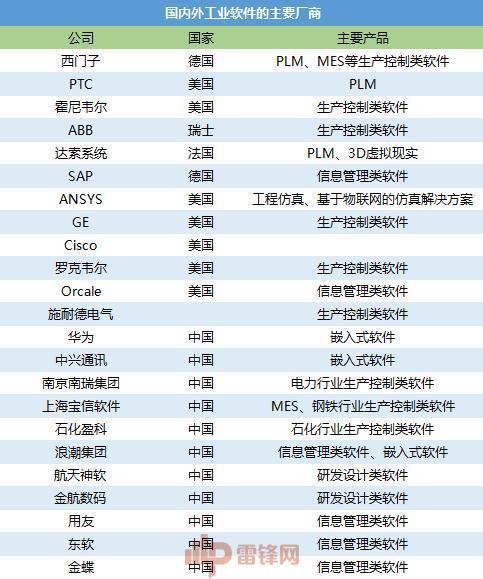
According to insiders, "If Siemens Germany now bans the NX software that integrates product design, engineering, and manufacturing in China's civil nuclear industry, it will be a disaster: all models designed with NX software and the management of production and manufacturing processes will be interrupted, and the entire industry will be greatly affected, even unable to operate normally
In addition, during the ZTE incident, Cadence, an American electronic design automation (EDA) company, responded to the call of the US Department of Commerce in April 2018 to ban the sale of electronic design software by ZTE, dealing a heavy blow to ZTE: "If electronic design software with a price of only a few million yuan on the procurement list is stopped, it will turn billions of chips into silicon soil
It is understood that the problem with proprietary software is that users purchase licenses but do not own or control the software, and licenses can be revoked at any time.
Therefore, some argue that "industrial software is the biggest weakness of China's manufacturing industry." So, what is the specific development status of China's industrial software?
As for the overall situation,SIE once summarized as "strong management software, weak engineering software, more low-end software, less high-end software." In addition, Cai Shenglong said:
The standards for industrial software in China are actually not clear, and the architecture of some systems is relatively backward. The integration capability of providing standards to the outside world is not very strong. In the implementation process, it will actually affect some of our information systems and business systems, including the integration of automation systems. Of course, embedded development software in China is relatively well done, such as Huawei
In addition, there are already a certain number of industrial software companies in China, but they have achieved relatively good growth in the general software market. In areas with stronger and more core industrial attributes, such as industrial data modeling and virtual simulation, which involve some complex core technologies of mathematical operations, we still need to continue to work hard to break through
As an independent industrial Internet platform manufacturer from the previous IoT department of Sany Heavy Industry, Rooted Internet's ROOTCLOUD platform is now an important member of the "national team". Regarding this, Tree Root Interconnect stated:
"At present, many industrial software is still positioned as a tool, which needs to be maintained and used by very professional personnel. As a universal thing, but in the current traditional industrial manufacturing enterprises, there is still a serious shortage of technical personnel from informatization, including software developers and intelligent technology. In particular, the consumer Internet like ours has led to the flow of a large number of software informatization personnel from traditional manufacturing enterprises to emerging Internet enterprises."
Kunlun Data, founded in 2014, has launched its own flagship product, the industrial big data platform KMX and the industrial Internet platform KSTONE, and is further exploring industrial software in proprietary fields. When it comes to the part of industrial software for external empowerment, they said:
There are many bottlenecks in the development of China's manufacturing industry, one of which is industrial software. In addition, there are core equipment for high-end manufacturing such as lithography machines and vapor deposition machines that cannot be produced, as well as core processes for some cutting-edge products. Of course, industrial software is the long-term accumulation and precipitation of industrial innovation knowledge, and is the brain of industrial product design and production. Currently, 80% of research and development design software and 60% of production control software are occupied by foreign brands. Under the strategy of building a strong manufacturing country and the current complex international situation, there is a strong demand for localization and self-reliance
In the critical period of "Made in China" accelerating to "Smart in China", these industrial software will inevitably be used in industrial Internet platform landing projects. So, how can our industrial Internet platform manufacturers solve this part of the work when they are doing digital and intelligent upgrading and transformation for industrial enterprises?
02 How can platform manufacturers adapt to industrial software challenges?
In December 2018, the Ministry of Industry and Information Technology put forward policy guidelines to accelerate the software transformation of industrial technology and the digital transformation of manufacturing industry.
Li Ying, from the Information Technology and Software Services Department of the Ministry of Industry and Information Technology, once stated at the Industrial Technology Software Forum and the "Million Industrial APP Lecture Hall" that the Ministry of Industry and Information Technology is actively supporting various forces to jointly promote the implementation of industrial technology software engineering through various forms.
Li Yizhang, Chairman of Suowei System, also pointed out that currently, the two fields of artificial intelligence and manufacturing cannot be integrated and interconnected. It is necessary to rely on industrial technology software to break down the barriers, and the core of realizing industrial technology software is industrial APP. He said:
"When industrial software resources are connected to the industrial Internet platform, developers and users of industrial APP will not even need to buy these expensive industrial software in the future."
In addition, as the scenarios that need to be empowered in the industrial field become increasingly complex, the requirements for digitization and intelligence are becoming higher, and the required industrial software is also more diverse. For example, in 2020, Xinyi developed the "X-PORT Port Safety Production Artificial Intelligence Management System", which empowers multi-dimensional scenarios such as port logistics, operation and maintenance, safety production, and efficient operation. The system includes one platform (Safety Production Management Platform), three subsystems (Port Visitor Reservation Management System, Container Yard Channel Personnel Safety Control System, Port Bridge Crane Safety Operation AI Visual Assistance System), and one hardware (Port Safety Production Special Camera). It is an industry level intelligent control system launched for the upgrading of port intelligence.
So, how do some industrial Internet platform manufacturers solve the problem of industrial software when implementing projects? How to achieve adaptability in an environment where there are more low-end software and fewer high-end software?
During the digital and intelligent transformation and upgrading of industrial enterprises, such as production control, data collection, equipment management, energy consumption management, and after-sales service management, Shugen Internet has always adopted a model of self-developed and industrial partners. That is to say, SaaS transformation of traditional industrial applications, allowing these industrial application software to grow on their root cloud platform, with the root cloud platform providing platform services. Based on this service, traditional industrial enterprises can use it through tree root interconnected industrial software or industrial enterprise partners' industrial apps.
There are two sources for the application development of its industrial software: one source is Sany Heavy Industry, which has deep applications in product intelligence, research and development, manufacturing, and services. Therefore, they have summarized a set of industrial software that is not only suitable for construction machinery, but also can be used across industries and fields; The other is the experience gained from Tree Root Interconnection, which has been independent for nearly four years and has served over 300 industrial enterprises. At present, Shugen Internet's self-developed industrial software includes Cloud Vision application, IFSM for intelligent on-site service process management, cloud networking, cloud control, unlocking machine, location management for engineering machinery management, as well as industry-specific applications such as Root Cloud Craftsman and Root Cloud Energy Management related to in plant manufacturing.
Industrial software covers a wide range, such as SCADA, PLM, CAD, CAE, and currently popular EDA, which are all industrial software; In addition, there are some management software, including advanced scheduling software, industrial software such as APS and MES for production control. For SIE Information, how do they solve it?
As an industrial Internet platform manufacturer, SIE solves the problem of industrial software from two aspects of independent research and development and software integration.
In terms of independent research and development, we have developed a SCADA system, also known as SMDC, mainly to meet the scenario requirements of online device connection monitoring. ”Cai Shenglong said:
It supports all standard protocols on the market, and also supports conversion and adaptation for some non-standard protocols. Our company has actually invested in industrial software in the manufacturing field for many years, including MES, APS, etc., and has already formed a complete product system, which has been widely used in various industries such as home appliances, furniture, semiconductor machining, etc
In terms of software integration, Leifeng.com learned that there are several types of industrial software that are currently relatively weak in China, such as R&D and design software, including CAD, CAE simulation systems, and DCS systems for controlling proprietary industrial equipment. These systems are often closely connected to hardware manufacturers and advanced manufacturing equipment from abroad. In these fields, in fact, foreign software companies such as PTC, Dassault, Siemens, etc. have formed absolute advantages in the market. When many industrial enterprises have used these software, SIE Information mainly provides customers with integration solutions in different industrial scenarios to ensure that enterprises are deeply connected in the industrial control process and improve their overall management efficiency.
The digitization and intelligent upgrading of industrial enterprises is a gradual process. We focus on the fields of digitization and intelligence, and have a complementary and intelligent relationship with automation and information software, "Kunlun Data said
Most of the companies we serve have already achieved a good level of digitalization. We are more of an additive and external brain, rather than a replacement. Therefore, we will actively promote cooperation with various industrial software and hardware manufacturers. At present, the industrial software or industrial APP we create includes applications in equipment failure warning, equipment operation efficiency improvement, industrial safety, product quality optimization, and other aspects
Industrial software and industrial apps not only require platform enterprises to seek solutions based on market demand, but also need to continue to make efforts at key points to meet the needs of industrial enterprises and improve the market competitiveness of domestic industrial software and industrial apps.
03 Continuous iteration of industrial software
Due to the fact that industrial software is the technological invention and accumulated experience of countless intelligent people, and has been repeatedly validated in various industrial scenarios, as well as products that have been continuously iterated and optimized over the years. But how long is this time span? 20 years? 30 years .....
Lei Feng Network learned that even tech giants such as Apple and Google find it difficult to quickly make a difference in the field of industrial software, because no matter how many product ideas and technological capabilities there are, it is difficult to cross the time threshold of mature industrial software.
In the current situation where "industrial software is the biggest weakness of China's manufacturing industry", how can players of industrial software and industrial apps in China make efforts? How to continuously iterate step by step?
"This continuous iteration depends on many aspects," Cai Shenglong of SIE said:
The continuous deepening of the scene, such as a chip, is different from 14 nanometers, 7 nanometers, and 5 nanometers. When experts are studying 25 nanometers, they only encounter some problems with 25 nanometers, and have no way of understanding the possible problems that may occur with 14 nanometers, nor can they understand the problems that should be encountered in the 5 nanometer process flowThe accumulation here is very solid step by step, and only with this gradient can we gradually solve our problems in this field. This long-term data accumulation and practice in application scenarios can truly solve this continuous iterative problem, and it is difficult to solve it through leapfrog development
In addition, Cai Shenglong also mentioned the aspect of talent and technology, stating:
In fact, continuous investment is also necessary in this area, because the investment cycle in the industrial software field is long and the iteration is relatively slow. For many enterprises, it is difficult to achieve the return on investment in the short term. Therefore, at this time, it is actually necessary for the leading enterprises in the industry to lead. For example, aircraft manufacturing plants like Lockheed in the United States are essentially industrial design companies that require a lot of talent, software, environment, and ecosystem support. This improvement depends on the guidance of the country and the establishment of an ecosystem of leading enterprises to form this accumulation and gradually break through
Shugen Interconnect originated from Sany Heavy Industry and has strong industrial attributes. It is very familiar with some of the needs of manufacturing enterprises. When it comes to building industrial software, Shugen Interconnect said:
When developing self-developed software, the first type is how to go deep into some usage scenarios of industrial enterprises, and truly make this industrial software have this value. It is very important to go deep into the scenarios. The second type is to try to meet the needs of industrial enterprises as much as possible, achieve plug and play, and meet some customer needs without or with less developmentOur self-developed series of software for full lifecycle management of OEM equipment is actually a summary of Sany Heavy Industry's more than ten years of experience in off-site equipment management. It is now widely used among customers in various industries
In addition, Leifeng.com learned that Shugen Internet has also collaborated with industry-leading clients to create industry-specific industrial application software. For example, they have partnered with Weihua Heavy Industry to create the Crane Cloud, Jack to create the Textile Cloud, Jufa to create the Boiler Cloud, and Fanuc to create the CNC Cloud.
In Kunlun Data's view, in the process of integrating information technology, data technology, and industrial technology, creating industrial software or industrial apps will face difficulties in integrating software ecology and production and operation processes, significant challenges in developing industrial app content, and difficulties in large-scale application and replication of industrial apps. The specific situation is as follows:
1、The integration of software ecology and production and operation processes is difficult. Integrating industrial apps into business processes to generate tangible implementation value requires the integration of knowledge from multiple professional fields. This places higher demands on both industrial app providers and consumers, therefore industrial apps need a good definition and integration approach. Kunlun Data is an area that is easy to focus on data-driven effects, such as equipment operation and maintenance, manufacturing execution, supply chain, and other fields;
2、The development of industrial app content presents significant challenges, especially for knowledge-based apps. On the one hand, there is uncertainty in expert knowledge, and on the other hand, industrial data is not comprehensive and accurate enough. IT technology also needs to have the ability to simplify the complexity of industrial scenarios when supporting the iterative verification of expert knowledge and data. Kunlun Data's methodology and tools, which have gradually evolved and internalized into the core competitiveness of its products and services, in defining business problems that can be solved by data and the experience behind solving them. They believe that to some extent, this will help their customers avoid detours and reach the fundamental value;
3、Large scale application and replication of industrial apps are difficult. This includes challenges in data technology (such as data inconsistency, network and communication issues) and promotion, operation and maintenance costs. Kunlun Data solves these challenges through lightweight and self maintaining end-to-end products, as well as flexible and highly adaptable data mapping technology. Industrial software and industrial apps are the coding of various industrial production processes, supporting the vast majority of manufacturing processes. How can China's industrial software industry better serve industrial enterprises and avoid the crisis of being "choked" during the acceleration of "China's intelligent manufacturing"?.
04 How to better serve『intelligent manufacturing in China』
At present, the industrial Internet industry is at the top of the wind. The Ministry of Industry and Information Technology's Guiding Opinions on Deepening the "Internet plus Advanced Manufacturing Industry" and Developing the Industrial Internet once proposed that 3-5 industrial Internet platforms with international competitiveness should be formed by 2025, and millions of industrial APPs should be cultivated and millions of enterprises should be put on the cloud.
However, it is difficult for industrial software and industrial APP to achieve leapfrog development. At this stage, how can our industrial software and industrial APP keep up with the rapid progress of the industrial Internet industry?
Cai Shenglong of SIE believes that there are three main points, specifically:
1、Firstly, due to the complexity of industrial scenarios, it is a vast ecosystem. So for all industrial software companies, I believe it is necessary to solve problems solidly in each scenario;
2、Furthermore, for the formation of the ecosystem in terms of industrial software standards, everyone should work together and develop the entire ecosystem;
3、Finally, we need to provide a better environment for industrial talents to continue innovating. The long-term investment return of enterprises may require certain policy guidance and promotion from the government.
Kunlun Data believes that industrial software and industrial apps will quickly respond to the needs of industrial enterprises in the future, such as lightweighting and independence; Driven by value and cost considerations, it also needs to be able to match the current development status of industrial enterprises; In addition, it is necessary to focus on bold independent innovation, try data-driven, new technologies, and new ideas.
In addition, in order to better serve 'China's intelligent manufacturing', it is necessary to 'create more industrial software that we can independently control.' Tree Root Interconnect believes that whether it is a platform based service enterprise like Tree Root Interconnect or some industry-specific software service enterprises, Tree Root Interconnect will strive to build a very complete and powerful platform with machine data access capabilities, including the access capabilities of software applications rooted in the Root Cloud platform.
Lei Feng Network learned that for service-oriented industrial software, Shugen Internet believes that it should continue to delve into this industry, constantly improve some industry attributes, and start from segmented industries to continuously upgrade and perfect. This should not only meet the needs of enterprise users, but also guide the production and operation management of enterprises, and be a teacher for enterprise production and operation management. Tree root interconnection can provide a foundation for platform enterprises and provide services for some industry-specific software service enterprises. The combination of the two provides comprehensive information services for Chinese manufacturing enterprises.
After the Two Sessions, where should the industrial software that restricts the development of China's manufacturing industry go? Will there be any new policies at the national level?


